
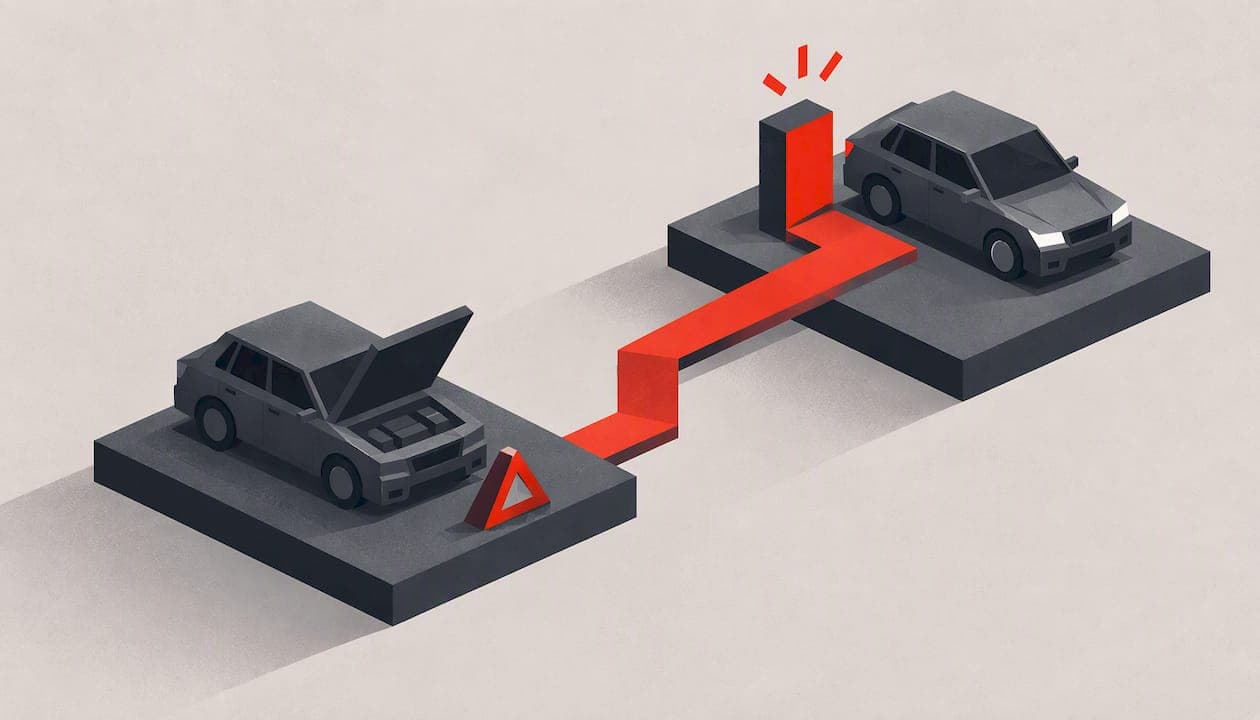
You turn the key and get a click, a slow groan, or nothing at all. Most of the time, that means a dead car battery. The fix is usually one of three things: a safe jump-start, a proper charge, or a new battery. This guide walks you through each one, shows you how to tell a drained battery from a failed one, and tells you when to stop and call for help. If you are stuck in the Lafayette area, we can come to you.
TL;DR
- Clicking, dim lights or a dead dashboard usually point to the battery. Check the terminals first, then try a jump-start by following your owner's manual.
- Never jump-start a battery that is cracked, leaking or frozen. Consumer Reports warns it can seriously hurt people and damage the car.
- If the car starts after a jump, let it run at least 20 minutes. If it dies again soon after, the battery or the charging system is the problem, not luck.
- A resting reading under about 12 volts means a discharged or weak battery. Most batteries last three to five years.
- Can't jump it, or it keeps dying? We bring the mechanic and the battery to your driveway, office or roadside.
Table of Contents
- How to tell it's the battery and not something else
- What to do first when your car won't start
- How to jump-start a dead car battery safely
- When a jump-start won't work
- Dead or just discharged? How to test your battery
- Can a dead car battery be revived?
- Why your battery keeps dying
- How to avoid the next dead battery
- Perspective: why we bring the battery fix to you
- Get help where your car is parked
- What to expect from a mobile battery visit
- FAQ
- Sources
How to tell it's the battery and not something else
A dead battery has a few classic signs. You do not need tools to spot most of them.
- The engine cranks very slowly, or you hear rapid clicking when you turn the key.
- The dome light and headlights are dim or off.
- The dashboard barely lights up, or it flickers and goes dark when you try to start.
- The car was fine yesterday but has sat for days.
The other possibilities are a bad starter, a failed alternator, a blown fuse or a fuel problem. Here is a quick rule of thumb. If the lights are bright but the engine won't crank, think starter. If the car starts with a jump but dies soon after, think alternator. If the lights are weak or dead, think battery.
A quick look under the hood helps too. Check that both cable clamps are tight on the posts. Look for white or blue-green crust around the terminals. Loose or corroded clamps can mimic a dead battery because power can't get through, even when the battery itself still holds charge.

What to do first when your car won't start
Stay calm and work through this list. It takes five minutes.
- Turn off everything: headlights, radio, A/C, phone chargers. Every little draw counts when the battery is low.
- Make sure you are parked somewhere safe. If you are on a road shoulder, turn on your hazard lights if there is any power left.
- Pop the hood and check the terminals for looseness and corrosion.
- Look at the battery case. If it is swollen, cracked or leaking, do not touch the cables and do not try a jump. Call a mechanic.
- If it looks fine and you have a helper car and a good set of jumper cables, try a jump-start.
If you do not have cables, or you do not feel comfortable working next to a battery, skip to the section on getting help. That is a perfectly good call, and it is often faster than waiting for a friend with cables.
How to jump-start a dead car battery safely
Your owner's manual is the final word, because some cars have special jump points or rules, especially newer models. Consumer Reports tells drivers to follow the manual, then park the cars close enough for the cables to reach without the vehicles touching, switch off both ignitions and connect the cables in the right order.
Here is the standard order:
- Connect one red (positive) clamp to the positive terminal of the dead battery.
- Connect the other red clamp to the positive terminal of the good battery.
- Connect one black (negative) clamp to the negative terminal of the good battery.
- Connect the last black clamp to a bare metal ground point on the dead car, away from the battery. A bolt on the engine block or a metal bracket works.
- Start the helper car and let it run for a couple of minutes.
- Try to start your car.
That last black clamp matters. Kia's owner guidance says not to connect the donor negative cable directly to the discharged battery's negative terminal. Use a metal ground point away from the battery instead. Batteries can give off flammable gas, and a spark right at the battery is the last thing you want. Keep flames and cigarettes far away.
Taking the cables off
Once the engine runs, remove the cables in reverse order. Start with the ground clamp on your car, then the negative clamp on the helper car, then the two red clamps. Don't let the clamps touch each other while any of them is still attached.
After the jump
If the car starts, keep it running. Consumer Reports says to let it run for at least 20 minutes before shutting it off. A short trip to the corner store is not enough. Drive steadily if you can, then get the battery tested soon. A jump gets you moving, but it doesn't tell you why the battery died.
When a jump-start won't work
Sometimes a battery is too far gone. Sometimes it isn't the battery at all. Stop and get help if:
- The battery is damaged, bulging, leaking or frozen. Consumer Reports is clear: do not jump-start a damaged or frozen battery.
- You connected everything correctly, waited, and the car still only clicks or cranks slowly.
- The car starts but dies again right after you remove the cables.
- You smell rotten eggs or see smoke or sparks.
If the car still won't start after a jump, there may be another problem. That could be a bad starter, a bad alternator, or a bad connection. Check the clamps once more, and if nothing changes, call a local service. That is exactly what our mobile mechanics do. We diagnose the issue where the car sits, so you do not need a tow just to find out what is wrong.
Dead or just discharged? How to test your battery
A discharged battery can be recharged. A failed battery can't. The difference matters because one is a free fix and the other is a replacement. A cheap multimeter shows you where you stand.
With the car off and the accessories off, touch the red probe to the positive post and the black probe to the negative post. Fluke's guidance gives these approximate resting readings:
| Resting voltage | What it usually means |
|---|---|
| About 12.6 V | Fully charged |
| About 12.4 V | Around 75% charged |
| About 12.2 V | Around 50% charged |
| Below 12.0 V | Likely discharged or weak |
Those figures come from Fluke's battery voltage guide, which also says a running engine should show about 13.7 to 14.7 V at the battery. That tells you the alternator is charging. If the reading with the engine running stays near the resting number, the alternator is probably not doing its job.
For the most honest reading, let the car sit. Haynes says a healthy battery should show roughly 12.6 V after the car has been sitting for at least one hour. A reading taken right after driving can look better than the battery really is.
Family Handyman adds a cranking test. It says a healthy battery should hold 9 to 10 volts while the engine cranks, and below 9 V is too weak. That test takes two people, one to crank and one to read the meter.
Why a voltage reading is only part of the story
A battery can show a decent resting voltage and still fail when asked to deliver real power. That is why a proper load test is better than a quick voltage check. It shows how the battery behaves under strain, which is what starting an engine actually is. Newer start-stop vehicles are more complicated again. Their batteries are built differently and need more careful testing than a standard one.
Don't want to buy a meter and learn the steps? Our general diagnosis is $150 and we do it at your location. We check the battery, the charging system and the starting system so you know what you are really paying to fix.
Can a dead car battery be revived?
Sometimes. It depends on why it died.
If you left the lights on or the car sat unused, the battery is probably just drained. Consumer Reports says a trickle charger or battery maintainer can replenish a drained battery. A full, slow charge is gentler than relying on a few minutes of driving.
Two cautions apply. First, a maintainer is built to preserve charge. It is not meant to resurrect a dead battery. Second, charge in a well-ventilated area and follow your owner's manual, because batteries can give off harmful or explosive gases.

You will see online tips about reconditioning a battery with Epsom salt and warm water. We would not bet your morning commute on that. If a battery has been deeply drained more than once, has a bad cell, or is several years old, it is on borrowed time.
Signs the battery needs to go
- It won't hold a charge. It starts after charging, then is flat again within a day or two.
- It is more than three to five years old. Consumer Reports says car batteries typically last three to five years.
- The case is swollen, cracked or leaking.
- Voltage stays low even after a full, proper charge.
Heat is rough on batteries, and Louisiana summers are long. Consumer Reports suggests annual load testing after age two in warmer climates (age four in colder ones). If you live in Acadiana and your battery is past two years, a yearly test is cheap insurance.
Why your battery keeps dying
One dead battery after a long weekend is normal. Repeated ones are a pattern. Common causes:
- Sitting too long. Consumer Reports notes that modern cars keep drawing power while parked, so a week or two of sitting can drain the battery. This is common for college students who leave a car at school or parents whose kids are away.
- Parasitic drain. Alarms, clocks and onboard computers pull a little power all the time. Haynes calls this parasitic loss and says it is a natural cause of drain in long-term storage. A faulty module or a stuck relay can make it much worse.
- Short trips. Starting the engine takes a lot of power, and a quick drive may not give it back.
- A weak alternator. If the charging system isn't putting out proper voltage, a new battery will die too.
- Loose or corroded terminals. Poor contact blocks charging as well as starting.
- Age. Old batteries lose capacity, and a hot summer often finishes them off.
If you replace a battery and it dies again, the battery was likely not the root problem. This is where guessing gets expensive. A real diagnosis saves you from buying parts you don't need.
How to avoid the next dead battery
A few habits go a long way.
- Test the battery once a year once it passes the two-year mark.
- Keep the terminals clean and tight.
- If the car will sit for more than a week or two, use a battery maintainer.
- Take longer drives now and then so the battery can recharge.
- Turn off lights and accessories before you shut the engine off.
- Replace the battery on your schedule, not the battery's. Don't wait for the slow crank to turn into a no-start on a work morning.
Small checks like these fit well into regular upkeep. Our post on extending your vehicle's lifespan with mobile maintenance covers more of them.
Perspective: why we bring the battery fix to you
We get calls from people standing next to a silent car in a parking lot, a driveway, or a campus lot. Almost all of them say the same thing: they just want to know what is wrong and what it will cost.
That is why we built our service around coming to you. A dead battery is stressful enough without arranging a tow, waiting at a shop and losing half a day. Our mechanics bring the tools and know-how to diagnose the problem on the spot, so you do not have to guess whether it is the battery, the alternator or the starter.
We believe in clear, upfront pricing. You get a quote before work starts, and our published rates for related work are easy to find: general diagnosis is $150, an alternator is $200 and a starter motor is $200. There is also a $40 travel or cancellation fee, which you can read about on our quote page.
If you are a parent whose student is stuck out of town, we can help in the Lafayette area without you having to be there. If you are a busy professional, we can work while you work. Our goal is simple: honest, effective service that gets you moving again.
Affordable
Get help where your car is parked
If a jump didn't work, or you would rather not touch a battery at all, we come to your home, workplace or roadside in Lafayette, Breaux Bridge, Carencro, Youngsville, Broussard and Duson. We test first, so you replace only what is actually broken.

See our battery services page, or look over our full list of services and prices. Want to know the cost before you commit? Our upfront quote page explains how pricing and the $40 travel or cancellation fee work. Not sure it is the battery? Start with a diagnosis. For more on what mobile service can handle, read about quick and reliable mobile automotive repair.
What to expect from a mobile battery visit
A mobile visit is simple. You tell us where the car is and what happened. We come to you, check the terminals, test the battery and look at the charging system. If the battery is just drained, we can tell you. If it has failed, or the alternator or starter is the real culprit, we explain it and give you the price before any work begins.
A few things make the visit smoother:
- Tell us the year, make and model of the car.
- Say what you heard or saw: clicking, slow crank, no lights.
- Let us know if the car has been sitting, and for how long.
- Park where we can reach the hood. Leave the key accessible if we need to test the car.
- If the car is a gift for a student or a relative out of town, share their location and phone number so we can reach them.
If you are choosing between a mobile mechanic and a tow, think about what you gain. A tow moves a problem car to a shop. We fix the problem where the car sits.
Buying a used car? A weak battery can hide a bigger issue. Our pre-purchase vehicle inspection is $150 and covers the car before you hand over any money.
FAQ
What do you do if your car battery is completely dead?
First check the terminals for looseness and corrosion, and look at the case for cracks or leaks. If it looks sound, jump-start it by following your owner's manual and keep the engine running for at least 20 minutes. If it will not jump, or the battery is damaged, call a mobile mechanic or a local service.
Can a car battery be so dead that it can't be jumped?
Yes. A damaged or frozen battery should not be jumped at all, and a battery with a dead cell may not take a charge. If the car still doesn't start after a correct jump, there may be another problem such as the starter or alternator. Have it tested where it sits.
How can I tell if the battery is bad or just dead?
Charge it fully and let it rest, then measure the voltage with the car off. About 12.6 V is a full charge, and below 12.0 V suggests a discharged or weak battery. If it won't hold a charge, or it is past three to five years old, plan to replace it.
Can a dead battery be revived?
A drained battery can often be brought back with a slow charge from a charger or maintainer. A battery that is old, damaged or has a failed cell usually can't. A battery that keeps going flat should be tested and probably replaced.
Sources
- How to Jump-Start a Car With a Dead Battery, Consumer Reports
- How a Car Battery Charger Can Prevent a Dead Battery, Consumer Reports
- Jump starting, Kia owner's manual
- How to Measure Battery Voltage with a Multimeter, Fluke
- How to Test a Car Battery with a Multimeter, Haynes
- How To Test a Car Battery, Family Handyman